 NinetySix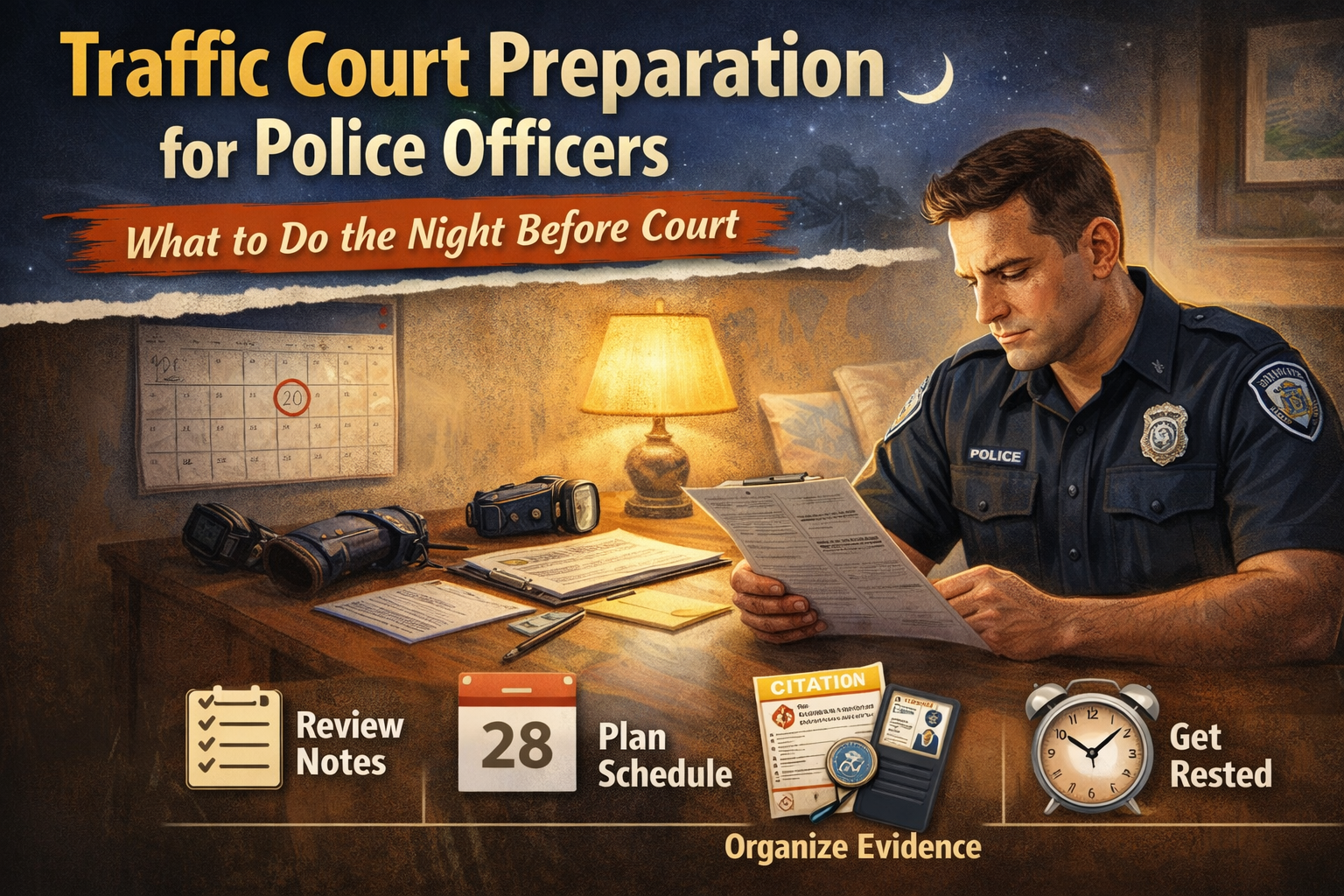
Preparing for traffic court isn’t just another task on your shift calendar—it’s a direct reflection of your professionalism, credibility, and attention to detail. As a police officer, your testimony can determine the outcome of a case. Even minor inconsistencies or forgotten details can weaken an otherwise solid summons.
The night before court is your opportunity to review, organize, and strengthen your case. With the right approach—and the right digital tools—you can walk into court confident, composed, and fully prepared.
In this guide, we’ll break down exactly what to do the night before court, how to streamline your preparation process, and how modern solutions like a Traffic Court Testimony Generator can help you save time while improving accuracy.
Why Night-Before Preparation Matters
Traffic court cases often involve multiple summonses, busy dockets, and tight timelines. Judges and hearing officers expect clear, concise, and consistent testimony.
If you:
- Misremember key facts
- Struggle to interpret handwritten notes
- Lose track of summons details
- Or contradict your written statement
…your credibility may be questioned.
Preparing the night before ensures your memory aligns with your documentation. Leveraging tools such as a New York Traffic Testimony Generator or a Traffic Violation Testimony Generator allows you to review your case details in structured, readable formats so you’re fully aligned with what’s on record.
Step 1: Review Every Summons Carefully
Start by gathering all summonses scheduled for court the next day.
What to Check
- Date, time, and location of the violation
- Specific statute or code cited
- Weather and traffic conditions
- Driver statements
- Any additional observations
Instead of manually decoding rushed handwriting, many officers now rely on a Police Summons OCR Tool to convert written summonses into clear digital text. This reduces the risk of misreading your own notes and ensures your testimony matches your documentation exactly.
An AI Summons Reader can further help by extracting critical details and organizing them in an easy-to-review format. That way, you're not flipping through paperwork late at night—you’re reviewing a structured summary.
Step 2: Reconstruct the Scene in Your Mind
Judges often ask clarifying questions. You need more than what’s written on the summons—you need context.
Ask yourself:
- Where exactly was I positioned?
- What first drew my attention to the vehicle?
- Was traffic heavy or light?
- How did I confirm the violation?
Using a Traffic Court Testimony Generator, you can convert your notes into a logical narrative that mirrors how you’ll present your testimony in court. This is especially useful when handling multiple cases in one session.
Officers working in New York traffic court often benefit from a TVB Testimony Generator, which formats testimony to align with Traffic Violations Bureau expectations and procedures.
Step 3: Verify Consistency Between Notes and Testimony
Consistency is everything.
Your testimony must match:
- The summons
- Body camera footage (if applicable)
- Radar or speed detection records
- Field notes
A Traffic Violation Testimony Generator helps eliminate gaps by building testimony directly from the summons details. This ensures nothing critical is omitted and reduces the chances of contradictions.
If you’re operating in New York, a New York Traffic Testimony Generator ensures your statements are structured in a way that aligns with local traffic court procedures.
This isn’t about changing your story—it’s about presenting the facts clearly and professionally.
Step 4: Organize Your Supporting Evidence
Beyond the summons itself, you may need:
- Radar calibration records
- LIDAR device information
- Training certifications
- Dash cam footage references
Have digital or physical copies ready. Review calibration dates and confirm equipment compliance. Judges often ask about certification or calibration status.
Preparing these details the night before eliminates stress and prevents last-minute scrambling.
Step 5: Practice Delivering Your Testimony
Reading silently isn’t enough. Say it out loud.
Clear testimony should be:
- Direct
- Chronological
- Free of unnecessary filler
- Professional in tone
Using a Summons to Testimony App, you can preview your structured testimony and rehearse it naturally. Practicing helps you identify awkward phrasing or areas where clarification might be needed.
The goal isn’t to sound scripted—it’s to sound confident and precise.
Step 6: Double-Check Administrative Details
Even strong testimony can be undermined by simple oversights.
Before bed, confirm:
- Court location and time
- Proper uniform or attire
- Required identification
- Court docket number
- Case scheduling
Using a Police Overtime Recorder App, you can also track your court-related hours accurately. Court appearances often qualify for overtime, and proper documentation ensures you’re compensated correctly.
The Police Overtime Recorder App not only helps track hours but also simplifies reporting and payroll documentation—saving time after court as well.
Step 7: Get Proper Rest
It may sound simple, but fatigue affects memory and delivery.
The best preparation strategy includes:
- Finishing review at a reasonable hour
- Avoiding last-minute stress
- Getting adequate sleep
When you combine preparation tools like a Traffic Court Testimony Generator with a disciplined night-before routine, you reduce anxiety and increase performance.
How Technology Is Transforming Traffic Court Preparation
Modern officers face increasing documentation requirements and heavier court calendars. Manual preparation methods are time-consuming and prone to errors.
Solutions like:
- AI Summons Reader
- Police Summons OCR Tool
- Traffic Violation Testimony Generator
- TVB Testimony Generator
- Summons to Testimony App
…are changing how officers prepare.
These tools convert raw summons data into structured, ready-to-review testimony, reducing preparation time while improving accuracy and consistency.
Why Choose Ninetysix.app for Traffic Court Preparation
At Ninetysix.app, we understand the unique challenges police officers face in traffic court. Our platform integrates powerful tools designed specifically for law enforcement professionals.
With Ninetysix.app, you can:
- Use a Traffic Court Testimony Generator to streamline testimony preparation
- Access a New York Traffic Testimony Generator tailored to local procedures
- Convert handwritten summonses using a Police Summons OCR Tool
- Leverage an AI Summons Reader for instant clarity
- Organize narratives with a Traffic Violation Testimony Generator
- Prepare for bureau hearings using a TVB Testimony Generator
- Track court hours with a Police Overtime Recorder App
- Transform reports using a Summons to Testimony App
Everything is built with one goal: to help officers present accurate, professional, and confident testimony in court.
Ninetysix.app is not just software—it’s a practical solution built around real-world police workflows.
A Simple Night-Before-Court Checklist
Here’s a quick summary you can follow every time:
- Digitize and review all summonses
- Use a Traffic Court Testimony Generator to structure testimony
- Confirm equipment calibration records
- Rehearse your statements aloud
- Verify court logistics
- Log hours in your Police Overtime Recorder App
- Get adequate sleep
Consistency in preparation leads to consistency in results.
Final Thoughts: Confidence Comes from Preparation
Traffic court isn’t unpredictable when you’re prepared. The night before court should be structured, efficient, and stress-free. By combining disciplined review habits with modern tools like a New York Traffic Testimony Generator or an AI Summons Reader, you eliminate guesswork and focus on delivering clear, professional testimony.
At the end of the day, your credibility is one of your most important assets.
If you’re ready to simplify your workflow, reduce preparation time, and improve courtroom performance, explore how Ninetysix.app can support your traffic court preparation.
Because when preparation becomes smarter, testimony becomes stronger.
For more updates and details, visit our Instagram Page!
FAQs
1. How does a Traffic Court Testimony Generator help police officers?
A Traffic Court Testimony Generator organizes summons information into a structured, court-ready narrative. It reduces errors, improves clarity, and helps officers stay consistent during testimony.
2. Is a New York Traffic Testimony Generator specifically designed for TVB hearings?
Yes, a New York Traffic Testimony Generator is designed to align with New York Traffic Violations Bureau procedures, making it easier for officers to present testimony that meets local court expectations.
3. What does a Police Summons OCR Tool do?
A Police Summons OCR Tool converts handwritten summonses into readable digital text. This prevents misinterpretation and ensures your testimony matches the original documentation.
4. How does the Police Overtime Recorder App benefit officers?
The Police Overtime Recorder App tracks court-related hours accurately, simplifying overtime reporting and helping officers ensure proper compensation.
5. What is the purpose of a Summons to Testimony App?
A Summons to Testimony App transforms summons details into organized testimony drafts, allowing officers to review, rehearse, and present their cases more effectively in court.