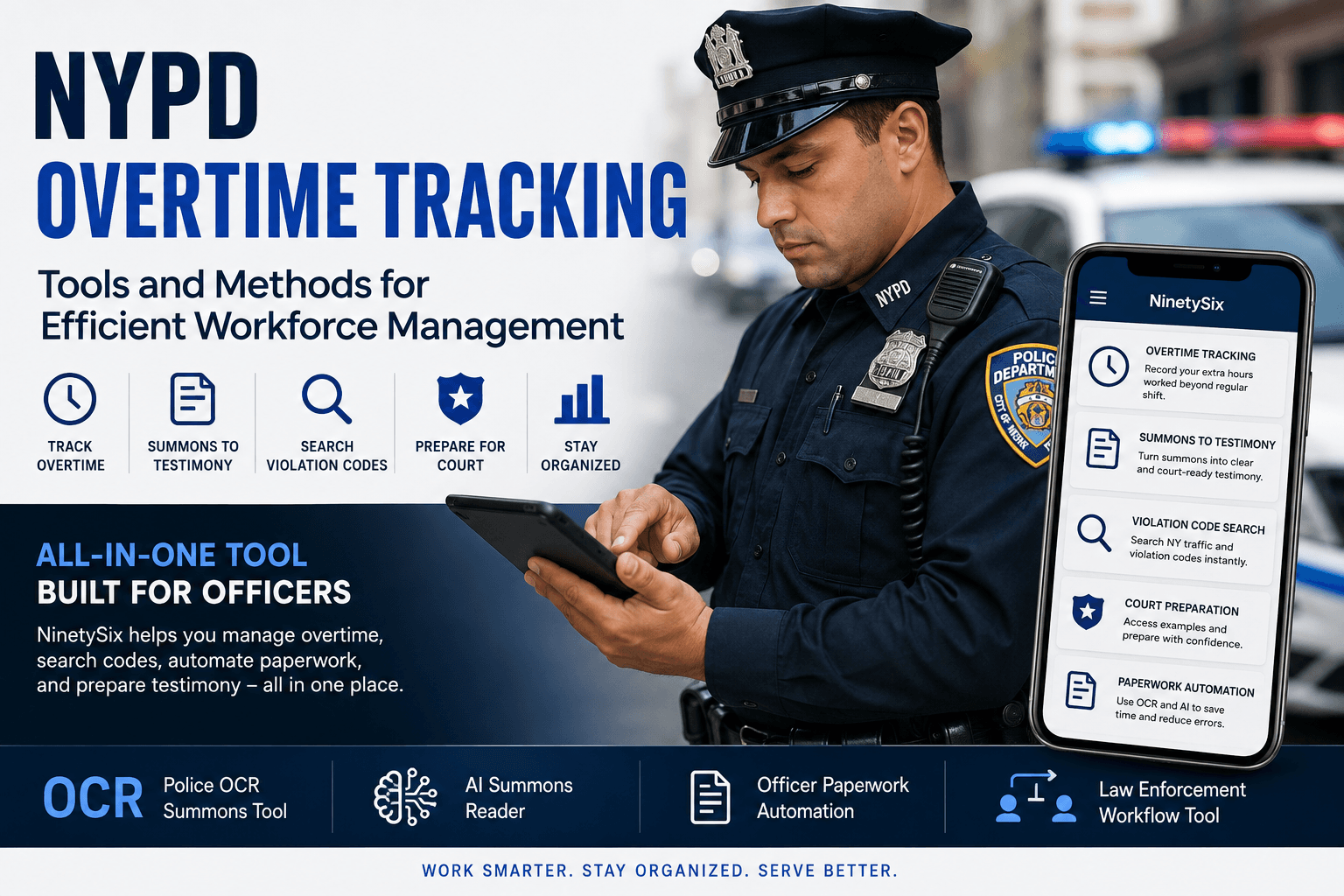
Police officers work long and demanding hours. Their work does not always end when a regular shift ends. An officer may spend extra time preparing paperwork, reviewing a summons, searching for a violation code, or getting ready for court.
Because of this, keeping an accurate record of extra working hours is important. A simple digital system can help officers record this time and keep their work organized.
Modern tools can also help with other daily tasks. Officers can search traffic codes, review summons information, and prepare testimony before court. When these tasks work together, officers can save time and reduce unnecessary paperwork.
Why Overtime Tracking Matters for Police Officers
Overtime can happen for many reasons. An officer may stay late after a traffic stop. Another officer may spend extra hours preparing for a court appearance. Sometimes, paperwork takes longer than expected.
Without a good tracking method, officers may forget when they started or finished extra work.
department overtime tracking can help officers keep a clear record of this time. Instead of using paper notes or trying to remember hours later, an officer can record the information immediately.
This makes personal time management much easier.
Accurate records also help officers understand how much extra time they spend on work outside their normal schedule.
The Problem With Manual Time Records
Many people still use notebooks, spreadsheets, or phone notes to record extra hours. These methods can work, but they are not always convenient.
Paper notes can get lost. A spreadsheet may require extra data entry. Phone notes can become difficult to organize when there are many entries.
A modern digital tool can make the process much simpler.
For example, a Police overtime recorder can allow an officer to record the date, working time, and reason for the extra hours. The officer can keep these records in one place and review them later.
This approach saves time and reduces the chance of forgetting important information.
One Tool Can Support More Than Overtime
Overtime is only one part of an officer's daily work.
Traffic officers may also need to check violation codes and prepare for court. These tasks can take a lot of time, especially when officers must search through different sources.
A NY traffic code search can help an officer quickly find information about a particular violation.
Similarly, a NY summons code lookup can help identify the correct code from a summons.
This is useful during a traffic stop, but it can also help later when the officer prepares court documentation.
Making Traffic Court Preparation Easier
Court preparation can be one of the most time-consuming parts of traffic enforcement.
An officer needs to remember the details of the event and explain them clearly. The officer may also need to review the summons and related traffic rules.
For example, an officer may need to prepare traffic court testimony before a court appearance.
A digital system can help organize the information from the summons. It can also make it easier to find the relevant violation code.
The officer still reviews the information and confirms that it matches what actually happened. The technology simply makes the preparation process faster.
Searching Violation Codes Quickly
Traffic officers deal with many different violations. Searching for the correct information can take time when using paper references or multiple websites.
A clear NY violation code explanation can help officers understand the rule connected to a summons.
Officers may also need NY traffic summons examples when reviewing how information should be organized.
The goal is simple. Officers should be able to find useful information quickly instead of spending a large amount of time searching.
This becomes even more important when an officer is working during a busy shift.
Preparing Different Types of Testimony
Not every traffic case is the same. Officers may handle speeding, failure to yield, improper turns, and many other violations.
For example, an officer may need VTL 1110a testimony for one case. Another case may require VTL 1111d1 testimony.
A speeding case may involve VTL 1180d speeding testimony.
There may also be cases involving Traffic Rule 4-03(a)(1) testimony.
Each case requires accurate facts. A technology tool should never create facts for an officer. Instead, it should help organize the information already recorded by the officer.
This makes preparation easier while keeping the officer responsible for reviewing the final content.
Handling Failure-to-Yield and Improper-Turn Cases
Common traffic violations can also require careful court preparation.
For example, Failure to yield NY testimony may require an officer to explain what the driver did and what the officer observed.
An Improper turn NY testimony case may require details about the vehicle's movement, road conditions, and the officer's observations.
These details can come from the original summons and the officer's records.
A digital tool can help place the information into a clear format. As a result, the officer can spend less time organizing notes and more time reviewing the facts.
Using OCR to Reduce Paperwork
Manual data entry can take a lot of time. It can also lead to small typing mistakes.
A Police OCR summons tool can help by reading information from a summons image and turning it into digital text.
OCR means Optical Character Recognition. In simple words, it helps a computer read words from an image.
An AI summons reader can provide additional support by helping identify useful information from the document.
This can reduce repetitive typing. However, officers should always check the information before using it.
Technology should make work easier, but accuracy must come first.
Officer Paperwork Automation
Paperwork is a normal part of police work. However, officers should not have to spend more time on basic data entry than necessary.
Officer paperwork automation can reduce repetitive tasks. Instead of entering the same information again and again, an officer can use digital tools to organize existing data.
For example, an officer could scan a summons, review the captured information, search the related code, and use those details to prepare for court.
This creates a smoother workflow.
Most importantly, the officer remains in control. The system helps organize the information, while the officer checks the accuracy.
From Summons to Court Testimony
Preparing testimony from a summons can be much easier when officers have the right tools.
A Traffic court testimony generator can help organize information from the summons into a useful preparation format.
A Summons to testimony app can make this process even more convenient. Instead of starting from an empty document, an officer can begin with information already available in the summons.
For example, an officer can review a TVB testimony sample to understand the type of information that may be needed for a Traffic Violations Bureau case.
The officer can then review the generated content and make sure it reflects the actual event.
This approach saves time while keeping human review at the center of the process.
A Better Way to Manage Daily Work
Officers often move between different tasks during the same day.
They may handle a traffic stop, search a code, write a summons, prepare paperwork, and later spend additional time preparing for court.
A good digital system should support this complete workflow.
A NY police documentation tool can help officers keep important information organized.
At the same time, a Law enforcement workflow tool can connect different tasks into one simple process.
The goal is not to add more work. The goal is to remove unnecessary steps.
Why Officer-Focused Tools Matter
Many workforce systems are built for large organizations and department managers. Individual officers have different needs.
They need tools that are quick, simple, and useful during real work.
NinetySix focuses on officers rather than departments.
It can help an officer search violation codes during a car stop or at another time. The officer can look up moving violations, administrative codes, and other information.
The platform can also help turn summons information into testimony preparation.
In addition, it can help officers maintain their own overtime records.
This creates one simple place for several tasks that officers may normally handle separately.
Making Overtime Records Easier to Manage
A good overtime system should not be difficult to use.
An officer should be able to record extra work without spending a lot of time entering information.
For example, an officer may finish a regular shift and then spend another hour preparing court paperwork. The officer can record that extra time in the system.
Over time, these entries create a personal record of additional work.
department overtime tracking becomes much easier when officers can record their hours as they work instead of trying to remember them later.
This simple habit can improve organization and reduce forgotten entries.
The Future of Police Workflows
Technology continues to change how people manage professional tasks. Police officers can also benefit from tools that reduce repetitive work.
Digital code searches, OCR, AI-assisted document reading, testimony preparation, and overtime recording can all save valuable time.
However, technology should support officers rather than replace their judgment.
The officer knows what happened during the traffic stop. The officer should review the final testimony and confirm every important detail.
The best tools simply make the process faster and easier.
Conclusion
Efficient time management is important for officers who regularly work beyond their normal hours. At the same time, court preparation and paperwork can add even more work to an already busy schedule.
A modern system can bring these tasks together.
NinetySix helps officers search violation codes, read summons information, prepare testimony, and keep track of extra working hours. It is designed for individual officers, not departments.
With the right digital workflow, officers can spend less time searching, typing, and organizing information. They can spend more time focusing on their actual work.