 NinetySix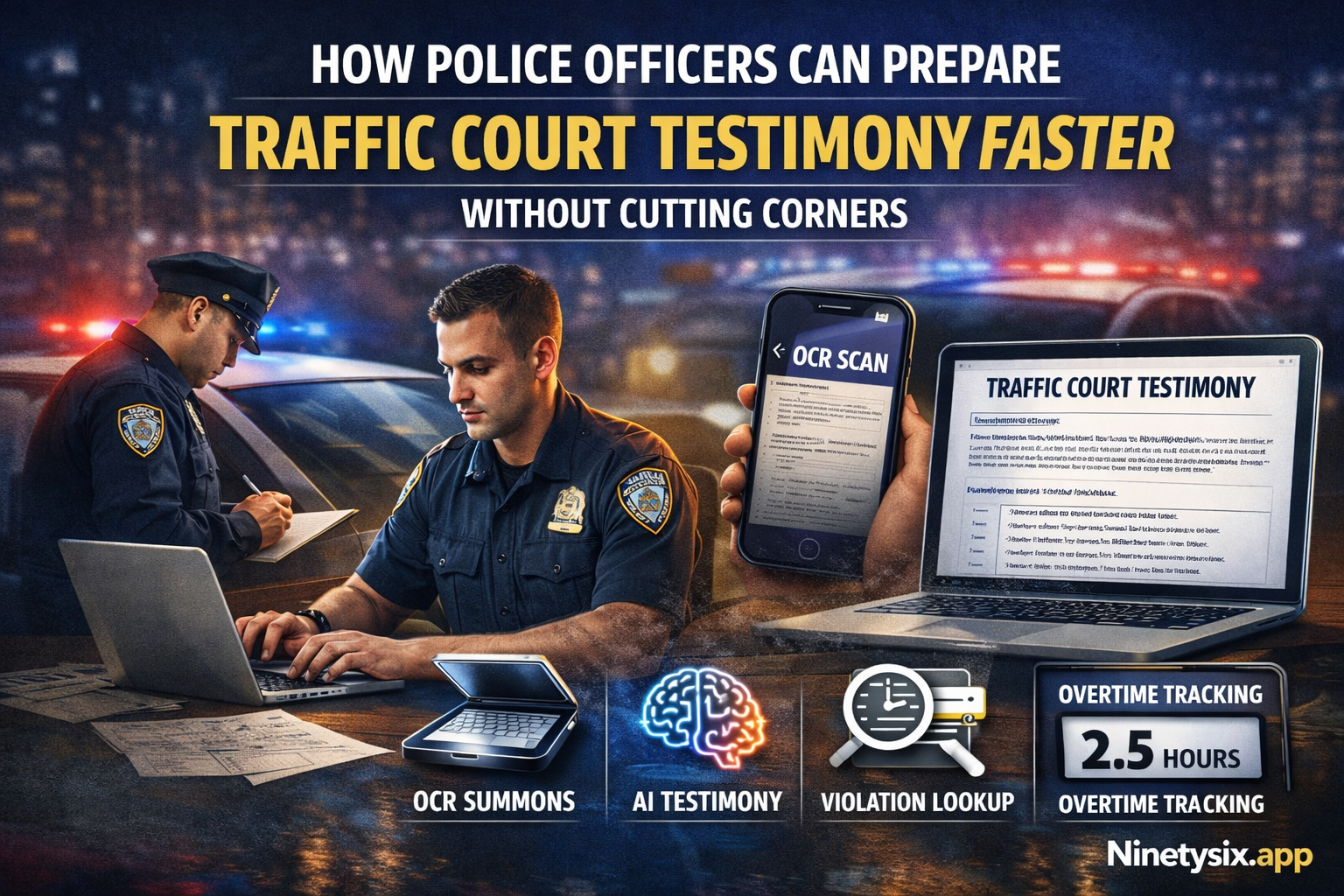
Preparing for traffic court has always been part of the job—but let’s be honest, it’s one of the most time-consuming parts. Between car stops, paperwork, overtime, and trying to remember details from weeks or months ago, court preparation can feel overwhelming. The good news? Speed does not have to come at the cost of accuracy.
Today, smart technology is helping officers prepare traffic court testimony faster without cutting corners, skipping steps, or risking credibility on the stand. With the right tools, officers can turn summonses into clear, court-ready testimony, manage overtime accurately, and reduce paperwork stress—all while staying compliant and professional.
In this guide, we’ll break down how police officers can streamline traffic court preparation, the challenges that slow things down, and how tools like Ninetysix.app are changing the workflow for individual officers across New York.
Why Traffic Court Preparation Takes So Much Time
Traffic court isn’t just about showing up—it’s about preparation. Officers are expected to recall facts clearly, present accurate documentation, and testify confidently.
Some of the biggest time drains include:
- Re-reading handwritten summonses
- Deciphering faded or rushed notes
- Searching for violation codes
- Reconstructing events from memory
- Preparing testimony outside regular duty hours
This is where officer paperwork automation becomes essential. Without it, officers often spend unpaid time preparing for court or struggle to track how much overtime they’ve actually worked.
The Real Risk of “Rushing” Testimony
Trying to prepare testimony too fast—without the right system—can lead to problems such as:
- Incomplete or unclear testimony
- Missed details that defense attorneys exploit
- Inconsistent statements across appearances
- Lost overtime hours due to poor tracking
Speed alone isn’t the goal. Accuracy, consistency, and efficiency are what truly matter. That’s why modern officers are turning to workflow tools built specifically for law enforcement.
How Technology Helps Officers Prepare Faster (and Smarter)
From Manual Notes to Digital Clarity
Instead of relying on memory or handwritten notes, officers can now use a Police OCR summons tool to instantly convert summons data into readable, structured text.
An AI summons reader scans summonses and extracts key information like:
- Violation codes
- Dates, times, and locations
- Vehicle and driver details
- Officer notes
This eliminates guesswork and dramatically cuts down preparation time.
Turning Summonses Into Testimony—Automatically
One of the biggest breakthroughs in court prep is the traffic court testimony generator.
Rather than writing testimony from scratch, officers can:
- Upload or scan a summons
- Let the system analyze the details
- Generate structured, court-ready testimony
A modern summons to testimony app ensures that nothing important is missed while keeping the language professional and accurate.
This doesn’t replace the officer’s judgment—it supports it.
Why This Matters for NY Officers Specifically
New York officers deal with a wide range of moving violations, administrative codes, and traffic infractions. Memorizing every statute or searching outdated reference materials wastes time.
A dedicated NY police documentation tool allows officers to:
- Search violation codes during a car stop
- Look up moving and administrative violations anytime
- Verify details quickly before the court
This level of access ensures confidence both on the street and in the courtroom.
Managing Overtime Without Guesswork
Court prep often happens outside regular shifts, which makes department overtime tracking a serious challenge.
Many officers lose track of:
- Prep time at home
- Court appearances on days off
- Extra hours reviewing summonses
Without accurate tracking, that time can go unpaid.
With a smart system in place, officers can:
- Log overtime instantly
- Keep a clean record of hours worked
- Stay organized for audits or reviews
This is where a law enforcement workflow tool becomes more than convenience—it protects officers’ time.
How Ninetysix.app Supports Officers (Not Departments)
Unlike systems designed for entire agencies, Ninetysix.app is built specifically for officers.
It helps individual officers:
- Prepare traffic court testimony faster
- Convert summonses into readable text
- Track overtime accurately
- Search violation codes on the go
- Reduce paperwork stress
Because it’s officer-focused, the experience is simple, fast, and practical.
Key Benefits of Using Officer-Focused Workflow Tools
1. Faster Court Preparation
Using an AI summons reader and traffic court testimony generator cuts prep time dramatically—without sacrificing accuracy.
2. Stronger, More Confident Testimony
When testimony is structured and based on verified summons data, officers walk into court prepared and confident.
3. Less Paperwork, Less Stress
With officer paperwork automation, officers spend less time rewriting notes and more time focusing on real police work.
4. Accurate Overtime Records
Built-in department overtime tracking ensures every hour worked is documented.
5. Reliable Documentation
A dedicated NY police documentation tool keeps everything organized and accessible when it matters most.
Preparing for Traffic Court Without Cutting Corners
Speed should never mean shortcuts. The goal is working smarter, not rushing.
Here’s how officers can do both:
- Capture clear information at the time of the stop
- Use a Police OCR summons tool to digitize records
- Generate testimony early, not the night before court
- Review details calmly instead of scrambling
- Track overtime consistently
A reliable summons to testimony app makes this process smooth and repeatable.
Common Misconceptions About Automation in Law Enforcement
Some officers worry that automation might:
- Replace their judgment
- Create generic testimony
- Remove personal accountability
In reality, tools like Ninetysix.app are designed to support, not replace, officers. The officer remains fully in control—technology simply removes unnecessary friction.
The Future of Traffic Court Preparation
Traffic court isn’t going away—but the way officers prepare is changing.
As more officers adopt smart solutions like a law enforcement workflow tool, we’ll see:
- Better prepared testimony
- Fewer dismissed cases due to errors
- Less unpaid overtime
- Reduced burnout
Efficiency isn’t about doing less—it’s about doing things right the first time.
Why Ninetysix.app Stands Out
Ninetysix.app brings everything together in one officer-friendly platform:
- AI-powered summons reading
- Court-ready testimony generation
- Violation code search
- Overtime tracking
- Secure documentation
Whether you’re preparing for court, reviewing a summons, or tracking extra hours, it’s built to fit real-world police workflows.
Final Thoughts: Faster Preparation, Stronger Testimony
Traffic court preparation doesn’t have to eat up your time—or your peace of mind. With the right tools, officers can prepare faster without cutting corners, stay organized, and protect their time.
If you’re tired of last-minute scrambling, unclear notes, and untracked overtime, it may be time to upgrade how you work.
Explore how Ninetysix.app can help you prepare smarter, testify stronger, and take control of your workflow.
For more updates and details, visit our Instagram Page!
FAQs
1. How does Ninetysix.app help with traffic court preparation?
Ninetysix.app uses an AI summons reader and a traffic court testimony generator to turn summons data into structured, court-ready testimony, saving officers hours of prep time.
2. Is Ninetysix.app designed for departments or individual officers?
It’s built specifically for officers, not departments. Officers can manage their own documentation, overtime, and court prep independently.
3. Can I track overtime related to court appearances?
Yes. The platform includes department overtime tracking, allowing officers to log prep time, court appearances, and off-duty work accurately.
4. Does the app help with violation code lookup?
Absolutely. It functions as an NY police documentation tool, letting officers search moving violations, administrative codes, and more—anytime.
5. Will using automation affect my credibility in court?
No. Automation supports accuracy and consistency. Officers remain fully responsible for their testimony, while the system helps organize and present information clearly.